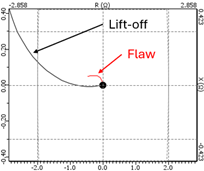
Flaw signal and lift-off signal superposition in CIVA ET
For some inspections sensitive to the lift-off signal, it is important to separate the flaw signal from the lift-off signal. The lift-off signal is then evaluated during the calibration phase, and a phase rotation is generally applied so that this signal is oriented in a particular phase, allowing it to be easily distinguished from the target flaw signal.
The Probe Response module of CIVA ET makes it easy to compute the lift-off signal for a given sensor and component. In this module, after defining the configuration, it is possible to define a range of variation for the lift-off at a given frequency and to quickly obtain the lift-off signal.
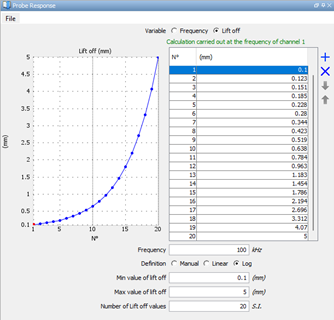
After the computation, the CIVA ET balancing tool  can be used to bring the lift-off signal back to the origin of the impedance plane, so that it can be compared more easily to a flaw signal. Then, a phase rotation can be applied so that the first part of the lift-off signal is aligned with a specific axis, for instance the negative X-axis here.
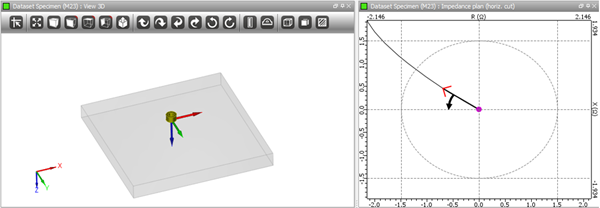
This phase rotation must also be applied to the target flaw signal before comparing the signals.
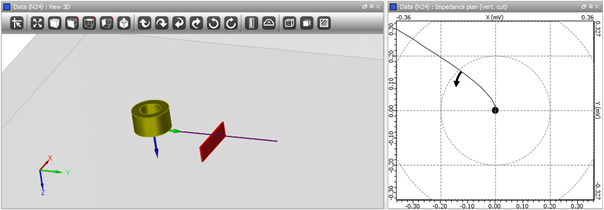
In CIVA ET, the signals can be compared by superimposing the two curves in the impedance plane, which then makes it easy to check whether the sensor and inspection parameters allow a good phase separation of the signals.